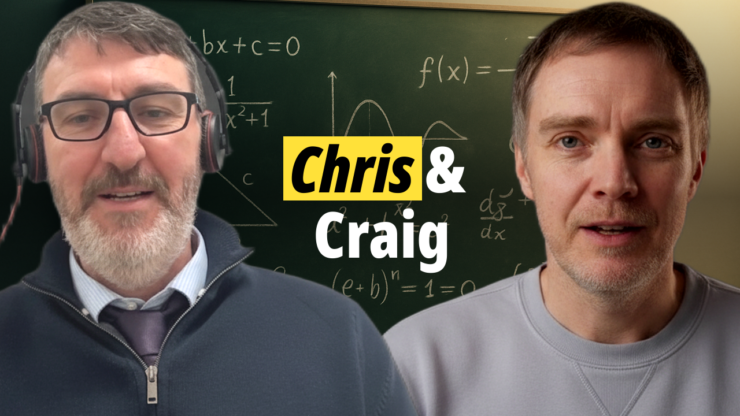
Craig Barton interviews guests from the wonderful world of education about their approaches to teaching, educational research and more. All show notes, resources and videos here: https://www.mrbartonmaths.com/blog/
In this episode of the Mr. Barton Maths podcast, Craig is joined by Chris Shaw, a mathematics educator with nearly 30 years of experience. They discuss Chris's transition from secondary school teaching to a full-time role at Loughborough University, where he is involved in teacher training and research. The conversation delves into the importance of effective explanations in mathematics education, the challenges of pursuing a PhD, and the role of sense-making in teaching. Chris shares insights from his research on what constitutes a good mathematical explanation and the significance of example selection in teaching. The episode concludes with reflections on the complexities of teaching and the ongoing quest for effective educational practices. Read the show notes here: podcast.mrbartonmaths.com/212-research-in-action-29-explanations-and-reasoning-with-chris-shore


Episode sponsor
This episode is part of my Research in Action mini-series, where I interview a researcher from the Mathematics Education Centre at Loughborough University about their chosen area of interest, and the implications for maths teaching and learning. You can check out all the previous conversations in the series here.
Revolutionise your Key Stage 3 mathematics teaching, with the LUMEN Curriculum
from Loughborough University! The LUMEN Curriculum is a completely free, fully resourced curriculum, built on the best-available research evidence from cognitive science, mathematics education and
educational design. Say goodbye to endless planning and hello to high-quality,
coherent materials, designed to deepen student understanding. Access the LUMEN curriculum resources here.
Episode details
In this episode of the Mr. Barton Maths podcast, Craig is joined by Chris Shore, a mathematics educator with nearly 30 years of experience. They discuss Chris’s transition from secondary school teaching to a full-time role at Loughborough University, where he is involved in teacher training and research. The conversation delves into the importance of effective explanations in mathematics education, the challenges of pursuing a PhD, and the role of sense-making in teaching. Chris shares insights from his research on what constitutes a good mathematical explanation and the significance of example selection in teaching. The episode concludes with reflections on the complexities of teaching and the ongoing quest for effective educational practices.
Takeaways
- Chris Shore has nearly 30 years of teaching experience.
- Transitioning from classroom teaching to university brings new challenges and rewards.
- Effective explanations are crucial in mathematics education.
- Pursuing a PhD can be both challenging and rewarding.
- Sense-making is a key component of effective teaching.
- Worked examples are powerful tools in mathematics instruction.
- Teachers often underestimate the importance of their explanations.
- The choice of examples can significantly impact student understanding.
- Research in education is complex and often messy.
- Collaboration among educators can enhance teaching practices.
Video:
New stuff I have been working on:
- My Tips for Teachers Guides to… series
- Our Eedi RCT and paper with Google
- My updated mrbartonmnaths website.
My usual plugs
- You can help support the podcast (and get an interactive transcript of this episode) via my Patreon page at patreon.com/mrbartonmaths
- If you are interested in sponsoring an episode of the show, then please visit this page
- You can sign up for my free Tips for Teachers newsletter and my free Eedi newsletter
- My online courses are here: craigbarton.podia.com
- My books are “Tips for Teachers“, “Reflect, Expect, Check, Explain” and “How I wish I’d taught maths”
Written summary:
Title: The Evolution of a Maths Educator: Insights from Chris Shore’s Journey
Introduction: In a world where education is constantly evolving, the stories of seasoned educators like Chris Shore provide invaluable insights. With nearly three decades of experience in teaching mathematics, Chris shares his journey from secondary school teacher to his current role at Loughborough University, shedding light on the joys and challenges of the profession.
Section 1: A Journey Through Mathematics Education
Chris Shore’s path to becoming a maths educator was not a straightforward one. Initially studying civil engineering, he found his passion for mathematics while at university. This unexpected shift led him to enroll in a PGCE program, where he began his teaching career. Chris candidly explains, “I stumbled into it… but I really fell in love with it.” His passion for teaching mathematics grew as he transitioned through various roles, including being the director of maths across a multi-academy trust.
Section 2: Transitioning from Classroom to University
After over 20 years at Beecham College, Chris made the significant decision to join Loughborough University. He reflects on this change, saying, “It’s quite a big change from being a secondary school teacher.” While he relishes the opportunity to work with renowned educators and contribute to innovative projects, he acknowledges the loss of the classroom’s vibrant atmosphere. “I miss some of the buzz of the classroom,” he admits, emphasizing the unique energy of engaging students.
Section 3: Teaching Future Leaders
At Loughborough, Chris is not just teaching mathematics; he is shaping the minds of elite sportsmen and women. He teaches a foundation course, aiming to bridge gaps in their mathematical knowledge. “Most of them don’t have A level maths… I’m reaching down into foundation maths,” he explains. This role challenges him to adapt his teaching methods to suit students who may be less enthusiastic about the subject, making it an exciting yet demanding experience.
Section 4: The Pursuit of Knowledge
In addition to his teaching responsibilities, Chris is pursuing a PhD focused on what makes a good mathematical explanation. “I became very interested in explanations… how to craft an explanation in the classroom,” he shares. This research stems from his desire to understand how different teaching methods can enhance students’ comprehension of complex concepts, such as trigonometry and differential equations. His passion for learning and improving educational practices is evident as he reflects on his academic journey.
Conclusion: Key Takeaways and Reflections
Chris Shore’s transition from classroom teaching to university education illustrates the dynamic nature of the teaching profession. His experiences highlight the importance of adaptability, continuous learning, and sharing knowledge with the next generation of educators. As Chris continues his research and teaching, he remains committed to enhancing mathematics education, proving that the journey of a teacher is one of constant evolution and discovery.
Tags: Mathematics Education, Teaching Journey, Loughborough University, PhD Research, Classroom Strategies, Educator Insights, Continuous Learning, Maths Teaching Strategies.