Craig Barton interviews guests from the wonderful world of education about their approaches to teaching, educational research and more. All show notes, resources and videos here: https://www.mrbartonmaths.com/blog/
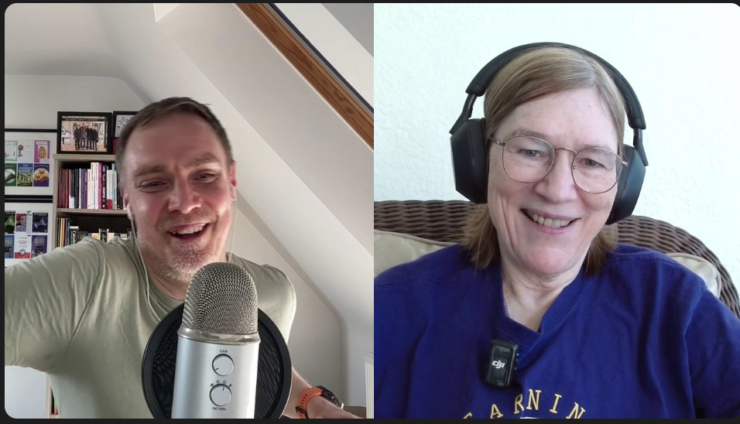
A long-awaited conversation with Barbara Oakley, distinguished professor of engineering, bestselling author, and creator of the world's most popular online course ”Learning How to Learn.” Barbara shares her remarkable journey from hating maths in school to becoming a champion of cognitive science-based teaching, and brings her expertise in memory and learning to bear on the rapidly evolving world of AI in education. Across four key areas—personalised tutoring, assessment, lesson planning, and teacher professional development—Barbara offers a refreshingly optimistic yet pragmatic take on how generative AI can support learning, while issuing strong warnings about the dangers of constructivist approaches in an AI-enabled world. She makes a passionate case for testing more (not less), for cognitive realist teaching over student-centred approaches, and for bringing the scientific method into education the way it transformed medicine. The conversation ranges from how AI helps her generate metaphors and surprises in her own teaching, to a fascinating insight into how large language models ”grok” patterns in ways that mirror human learning. View the show notes here: podcast.mrbartonmaths.com/216-ai-in-education-with-barbara-oakley


Episode sponsor
Maths teachers have built a free ChatGPT app that can generate worksheets directly in chatGPT, with proper mathematical notation, graphs and even diagrams!
To get started, search “Worksheet” in the ChatGPT App store. Prompt the Strive PDF Generator to create whatever you need: unit tests, homework or quizzes, then just download the fully-formatted PDF. No latex knowledge or copy-paste required.
Go to worksheet.chat to get started.
Episode details
A long-awaited conversation with Barbara Oakley, distinguished professor of engineering, bestselling author, and creator of the world’s most popular online course “Learning How to Learn.” Barbara shares her remarkable journey from hating maths in school to becoming a champion of cognitive science-based teaching, and brings her expertise in memory and learning to bear on the rapidly evolving world of AI in education. Across four key areas—personalised tutoring, assessment, lesson planning, and teacher professional development—Barbara offers a refreshingly optimistic yet pragmatic take on how generative AI can support learning, while issuing strong warnings about the dangers of constructivist approaches in an AI-enabled world. She makes a passionate case for testing more (not less), for cognitive realist teaching over student-centred approaches, and for bringing the scientific method into education the way it transformed medicine. The conversation ranges from how AI helps her generate metaphors and surprises in her own teaching, to a fascinating insight into how large language models “grok” patterns in ways that mirror human learning.
Key topics
- Barbara’s journey from failing seventh-grade algebra (reading history books in class) to becoming a distinguished engineering professor who fell in love with maths at 26
- Why she was an early adopter of generative AI thanks to her colleague Terry Sejnowski, and how proto-ChatGPT helped her create multiple-choice questions before the technology went mainstream
- The lovehate relationship: AI as a brilliant research assistant versus the way it has “pulled the rug out from under us as teachers”
- Why metaphors are one of the most powerful uses of AI tutoring—and how to ask for a different one when the first doesn’t click
- The crucial caveat that AI tutors only work when students are motivated, which makes teachers more important, not less
- The medication dosage example: why students MUST internalise foundational knowledge (like times tables) to think critically about AI outputs
- Barbara’s daughter’s 10 years of Kumon as a case study in how repeated practice builds genuine number sense—and why constructivist approaches that dismiss memorisation are doing real harm
- The two memory systems and why one of them “thrives on repetition”—learning maths fluency works the same way as learning your native language
- The homework-is-dead problem: why any assessment outside the classroom is now essentially worthless for gauging student understanding
- Barbara’s strong critique of student-centred constructivist approaches and her case for “cognitive realist” teaching based on how the brain actually learns
- Why we need to test students MORE, not less—and the difference between low-stakes weekly retrieval quizzes and high-stakes national tests
- Her observation that schools without testing often produce worse outcomes than those with it (paper airplane building before national tests as a memorable image)
- The “taxonomy of excuses” for why constructivist approaches persist despite contrary evidence
- Why teachers shouldn’t have to write their own textbook for every class they teach—and what New Zealand gets wrong by demanding teachers create their own materials
- A nuanced take on highly scripted curricula like Engelmann’s Connecting Maths Concepts: the trade-off between great teachers’ creativity and the reality that “half of all teachers are below average”
- How Barbara uses ChatGPT to generate hooks, surprises, and active learning activities to break up her lectures—and why surprise is so powerful for memory
- A scathing critique of schools of education for teaching century-old pedagogy from Dewey, Vygotsky, Piaget, and Montessori instead of modern cognitive science
- The reading wars as a cautionary tale: why phonics consistently wins the evidence battle but whole language keeps returning, and the lesson of the Mississippi Miracle
- The “paradigm cartel” problem in education and why government intervention has sometimes been necessary to overcome it
- Why education needs to undergo the same scientific revolution that medicine underwent two centuries ago
- A fascinating tangent on “grokking” in large language models—how AI is helping us understand why deliberate practice and repetition lead to intuitive, transferable knowledge
- Barbara’s optimistic vision of a future classroom where evidence-based teaching meets thoughtful technology, with less harmful tech (like social media) and more genuinely useful tools
- The dual-use warning: AI as a knife—every technology has a good and bad side, and the real danger is always the people behind it
- Resources for listeners: Uncommon Sense Teaching, A Mind for Numbers, and her Coursera courses including Learning How to Learn and Making Math Click with John Mighton
Video:
Links from Barb
New stuff I have been working on:
- My Tips for Teachers Guides to… series
- Our Eedi RCT and paper with Google
- My updated mrbartonmnaths website.
My usual plugs
- You can help support the podcast (and get an interactive transcript of this episode) via my Patreon page at patreon.com/mrbartonmaths
- If you are interested in sponsoring an episode of the show, then please visit this page
- You can sign up for my free Tips for Teachers newsletter and my free Eedi newsletter
- My online courses are here: craigbarton.podia.com
- My books are “Tips for Teachers“, “Reflect, Expect, Check, Explain” and “How I wish I’d taught maths”
Write-up of the episode
- My 5-takeaways write-up is here.