Craig Barton interviews guests from the wonderful world of education about their approaches to teaching, educational research and more. All show notes, resources and videos here: https://www.mrbartonmaths.com/blog/
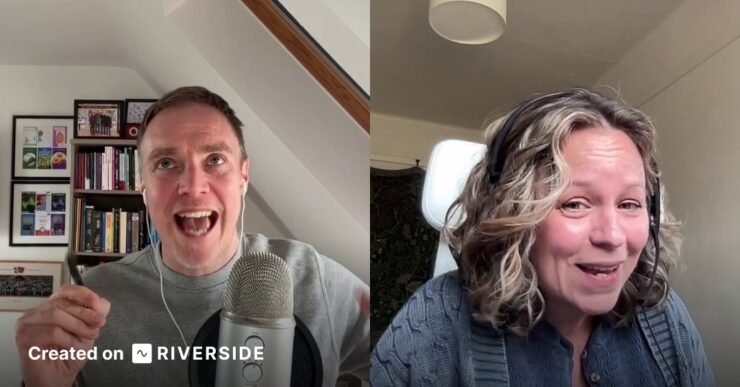
In this long-awaited sequel (eight years after her last appearance), Craig welcomes back Becky Allen — education researcher, co-founder of Teacher Tap, co-author of The Teacher Gap, and now a consultant to the US-based Alpha School chain — for a deep dive into AI in education, with a particular focus on AI as a personal tutor. Becky is a self-confessed AI optimist who uses LLMs for almost everything (with a fervent endorsement of WhisperFlow voice transcription as a game-changer for giving models richer context). She walks through what she's been seeing inside Alpha School, where students do roughly two hours a day on AI-powered learning apps and spend the rest of their time on project-based learning, sports, and life skills. Her clearest examples of where AI tutoring genuinely shines are in generative prerequisite-knowledge conversations and in forcing students to engage step-by-step with worked examples — pulling them out of the passive eye-darting that kills most textbook learning. From there, Craig walks her through a battery of common sceptical pushbacks (screen time, scalability, Alpha's wealthy demographic, motivation without an audience, the Khanmigo flop, applicability to the Global South, and the future of subject-specialist teachers) and Becky pushes back on each with characteristic nuance. Her core thesis: AI won't transform mainstream schools much — they're too operationally complex to bend — but it will enable a parallel world of micro-schools, alternative provision, and remote subject specialists, particularly for the growing population of persistently absent and home-educated children. The conversation closes with reflections on whether AI will take her own job (and what to advise her children) and a prediction that the most concrete thing AI will fix in mainstream schools is marking. View the show notes here: podcast.mrbartonmaths.com/222-ai-in-education-with-becky-allen


Wispr Flow
If you heard Becky and me raving about the AI voice transcription to Wispr Flow and want to get a free month, then just click this link, and you’ll be helping me out because I get a free month too.
Episode details
In this long-awaited sequel (eight years after her last appearance), Craig welcomes back Becky Allen — education researcher, co-founder of Teacher Tap, co-author of The Teacher Gap, and now a consultant to the US-based Alpha School chain — for a deep dive into AI in education, with a particular focus on AI as a personal tutor. Becky is a self-confessed AI optimist who uses LLMs for almost everything (with a fervent endorsement of WhisperFlow voice transcription as a game-changer for giving models richer context). She walks through what she’s been seeing inside Alpha School, where students do roughly two hours a day on AI-powered learning apps and spend the rest of their time on project-based learning, sports, and life skills. Her clearest examples of where AI tutoring genuinely shines are in generative prerequisite-knowledge conversations and in forcing students to engage step-by-step with worked examples — pulling them out of the passive eye-darting that kills most textbook learning. From there, Craig walks her through a battery of common sceptical pushbacks (screen time, scalability, Alpha’s wealthy demographic, motivation without an audience, the Khanmigo flop, applicability to the Global South, and the future of subject-specialist teachers) and Becky pushes back on each with characteristic nuance. Her core thesis: AI won’t transform mainstream schools much — they’re too operationally complex to bend — but it will enable a parallel world of micro-schools, alternative provision, and remote subject specialists, particularly for the growing population of persistently absent and home-educated children. The conversation closes with reflections on whether AI will take her own job (and what to advise her children) and a prediction that the most concrete thing AI will fix in mainstream schools is marking.
Talking points
- Reuniting after eight years: Becky’s last appearance was November 2018 when she’d just published The Teacher Gap with Sam Sims — a book Craig considers underrated and still depressingly current on systemic teacher workforce problems.
- Teacher Tap origins and ongoing value: Born in 2017 with Laura McInerney out of frustration at unverified claims by journalists and politicians; now polling 10,000+ teachers a day on everything from colour photocopying access to classroom behaviour, painting a long-term picture of the profession.
- Becky’s AI origin story: A PhD-era familiarity with image classification and neural nets meant she “knew what she was seeing” when ChatGPT arrived; she’s been an unusually committed optimist about model capability, partly because she’s “not very romantic about the human brain.”
- WhisperFlow as a paradigm shift: Voice transcription isn’t just a time-saver — because LLMs thrive on context, the ability to ramble for five minutes gives the model far richer instructions than the compressed summaries we tend to type.
- Why blog posts are still hand-typed: LLMs flatten arguments and strip out the spiky, novel bits — when Becky starts publishing daily on her Substack, you’ll know an LLM has finally cracked it.
- The jagged frontier of model strengths: Becky is currently down on Claude 4.7 (slow, lazy), bullish on the latest GPT models for image generation, and only uses Gemini as a critical reviewer of her drafts — never to write.
- Two types of educational image: Mathematically structured images (which Python-aware LLMs like Claude can now generate beautifully, even as animations) versus pictorial images for biology and chemistry, where the tooling still struggles.
- Becky’s day job at Alpha School: Consulting on assessment, instructional design, and evaluating learning apps for the US chain where students do two hours of AI-powered learning per day and the rest as projects, sport, or life skills.
- What learning apps can now do that they never could: Formative assessment on open-ended student responses, opening up subjects beyond maths/CS/physics that were previously hard to build apps for.
- Generative prerequisite knowledge checks: Instead of a multiple-choice “remember Pythagoras?” quiz, the LLM has an adaptive three-minute conversation — pushing top students further while walking weaker ones through the basics.
- Forcing engagement with worked examples: LLMs can split a worked example into stages and require the student to articulate what’s happening at each step, cutting through the “eye-darting” passive reading that plagues textbooks.
- What LLMs still can’t do well: Build up complex diagrams step-by-step with synchronised verbal explanation — the kind of board work a great maths teacher does live. Until this is solved, online maths learning will remain limited.
- Why teacher-in-the-loop isn’t part of the Alpha model: The platform is the teacher; no whole-class discussion of interesting student responses, because what’s “interesting” depends on a student’s current readiness.
- Spaced retrieval is mostly solved — for maths: Cold-start algorithms work fine for fixed-form retrieval, but spacing flexible, evolving knowledge (the kind needed in other subjects) is a genuinely unsolved problem.
- The screen-time pushback: Two hours isn’t excessive; Alpha kids get more social interaction than typical secondary students sitting in rows for five hours. The real unresolved issues are around handwriting, drawing, and constructing meaning physically — partly worked around by getting students to hold paper up to the camera.
- Is Alpha School too rich/small/unrepresentative to learn from? Becky’s answer: of course it’s a benign environment — that’s the point. You build in benign environments and figure out what scales. Software costs will fall to zero (cloning); LLM inference costs are already falling fast; the staffing model (1:20 guides) isn’t far off mainstream ratios.
- Will behaviour-challenged kids sit still for two hours? Becky thinks yes — the contract is much tighter than typical school (no XP, no afternoon sport), and Alpha’s sports academy in particular leverages this brilliantly.
- The micro-school possibility: Alpha schools have just 50–100 kids each because they don’t need scale to deliver subject specialists. This makes them genuinely viable for the 20% of UK students who are persistently absent or in elective home education — the most under-served population.
- Would Becky send her own kids to Alpha? Probably not — they’re 12 and 15 and thriving in a big comprehensive where her daughter sings in two pop bands (impossible at a school of 50). Plus the American curriculum (thin Common Core, no proper public exams) is unappealing compared to GCSEs and A levels.
- What Alpha has got wrong: The gap between the two-hour learning block and the afternoon project work — there’s no space for kids who genuinely love a subject to dive deeper into its history, beauty, or origins (which English maths education also fails at).
- Dan Meyer’s pushback — kids don’t perform for an AI: Becky’s response: it’s a testable hypothesis, not a universal truth; Alpha kids still have human guides they know well; and there are many reasons students work hard — Dan’s story isn’t the only one.
- Craig’s romantic notion — the magical classroom moment: Becky’s pragmatic response: are we describing variance or average? Most lessons don’t feel magical. Trading peak collective moments for higher average learning efficiency is a value judgment, not an obvious loss.
- Michael Pershing’s pushback — kids will game the tutor: Alpha barely uses AI tutors for this reason; the Khan Migo experience suggests open-ended student-driven AI tutoring is largely a dead end. Apps need to control the path tightly — student choice usually isn’t productive.
- Why Khan Migo failed: When learning is voluntary and effortful, kids switch off — they always pick the shortest cut. AI tutoring is brilliant when you desperately want to learn something (Becky uses ChatGPT this way for biology she needs to understand), but school learning is fundamentally not that.
- The Global South: AI tutoring there is a long way off — not just devices and connectivity, but the underlying economic structures that make education worthwhile. Not as easily solvable as people think.
- The future of teachers and subject specialists: Alpha does have subject specialists — they’re remote “coaches” you book via a button when stuck. AI won’t transform mainstream schools (Adam Boxer is right about this), but parallel models will spring up, especially in alternative provision and private sectors.
- How change actually happens: Not by retraining teachers — by smaller schools shrinking below the viable-specialist threshold, forcing a mixed economy where some subjects (Further Maths is the obvious one) are delivered online by specialists across many schools.
- AI taking Becky’s job: She’s “really really old” and can float to retirement, but worries genuinely about her children’s career prospects — Teacher Tap’s own engineering and data teams have already shrunk because one person now controls a lot more output.
- The future-school prediction: Mostly the same. Independent-study platforms much better, but cheating much worse — Becky’s most optimistic vision is government-funded extended-hours schools where independent study happens on-site. Marking, finally, gets resolved.
Video:
Links from Becky:
- Becky’s Substack (Prof Becky Allen),
- Her assessment-focused Substack with Matt Evans (100% Assessment),
- Teacher Tapp if you are a teacher in England and not already on it.
- Becky’s book, The Teacher Gap, is available from Amazon here
New stuff I have been working on:
- My Tips for Teachers Guides to… series
- My updated mrbartonmnaths website
My usual plugs
- You can help support the podcast (and get an interactive transcript of this episode) via my Patreon page at patreon.com/mrbartonmaths
- If you are interested in sponsoring an episode of the show, then please visit this page
- You can sign up for my free Tips for Teachers newsletter and my free Eedi newsletter
- My online courses are here: craigbarton.podia.com
- My books are “Tips for Teachers“, “Reflect, Expect, Check, Explain”, “How I wish I’d taught maths”, and my Tips for Teachers Guide to… series.